AI Operations
Everyone Wants an AI Agent. Here's What Your Business Actually Needs First.
8 min read · July 13, 2026
AI agents are everywhere, but most businesses aren't ready for them. Discover why clean processes, connected systems, and quality data matter more than deploying an AI agent too early.
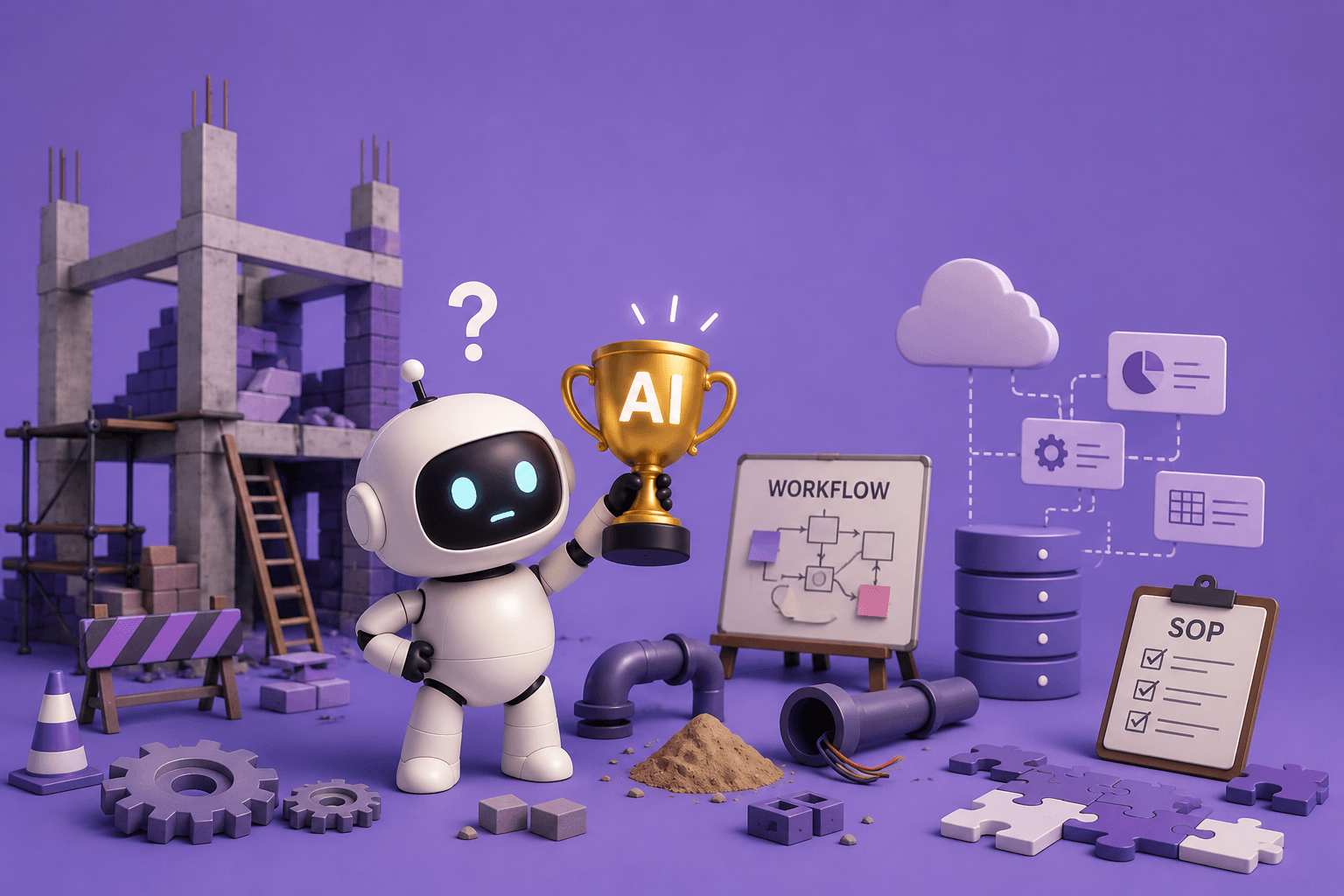
Walk into any business meeting in Dubai right now and someone will bring up AI agents within the first ten minutes. It's the word of the moment. Everyone wants one. Nobody's quite sure why.
Ask five business owners what an AI agent would actually do for them, and you'll get five different answers most of them vague, some of them borrowed straight from a LinkedIn post. "It'll handle customer service". "It'll automate everything." "It'll basically run itself".
Here's the uncomfortable truth: most businesses chasing AI agents aren't ready for one. Not because the technology isn't good enough it is but because they haven't done the groundwork that makes an agent useful instead of expensive.
This isn't an anti AI agent article. It's a "let's actually get this right" article. Because when businesses skip the fundamentals and jump straight to the shiniest AI solutions in Dubai have to offer, they end up with a very sophisticated tool that nobody trusts, nobody uses, and everybody quietly stops talking about six months later.
Let's talk about what actually comes first.
The AI Agent Hype, Explained
Before we get into what your business needs, it's worth understanding why "AI agent" became the phrase of 2026.
An AI agent, in simple terms, is software that can take a goal, break it into steps, use tools, and complete tasks with minimal human input. Book a meeting. Answer a support ticket. Pull data from three systems and generate a report. It's not just answering questions like a chatbot it's doing things.
That's genuinely powerful. It's also genuinely overhyped, because the marketing around agents makes it sound like you can drop one into your business and watch chaos turn into order overnight.
In reality, an agent is only as good as the systems, data, and processes it's operating inside of. Drop an agent into a business with messy data, no clear workflows, and disconnected tools, and you don't get magic you get a fast, confident system making fast, confident mistakes.
This is where AI implementation conversations usually go wrong. Businesses want the outcome speed, savings, scale without doing the unglamorous work that makes the outcome possible.
What Your Business Actually Needs First
Here's the honest checklist. Not the exciting one. The one that actually works.
1. Clean, Connected Data
Every AI system agent or otherwise runs on data. If your customer information lives in one spreadsheet, your inventory in another system, and your sales team's notes in someone's WhatsApp chats, no agent on earth can stitch that together into something reliable.
This is the least glamorous part of any AI project, and it's also the most important. Digital transformation doesn't start with the flashy AI layer on top it starts underneath, with getting your data into one place, in a consistent format, that systems can actually read.
Ask yourself:
● Do your different tools talk to each other, or are they isolated islands?
● Is your data current, or full of duplicates and outdated entries?
● Can someone pull a straight answer to "how many active customers do we have" in under a minute?
If the answer to any of these is a wince, that's your starting point. Not the agent.
2. A Process Worth Automating
A lot of businesses want automation for processes that are broken in the first place. Automating a broken process doesn't fix it it just makes the broken thing happen faster and with less human oversight to catch the errors.
Before automating anything, map the process on paper (or a whiteboard, or a napkin, genuinely doesn't matter). Who does what, when, and why. You'll often find that half the steps exist because "that's how it's always been done," not because they add value.
This is the real starting point for business process automation not tools, but clarity. Fix the process first. Then automate the clean version, not the messy one.
3. Clear Ownership and Accountability
Somebody has to own the AI system once it's live. Not in a vague "IT will handle it" way someone specific, with the authority to say "this isn't working, let's adjust it".
A huge number of AI projects fail quietly because nobody was assigned to monitor outcomes, catch errors, or update the system as the business changes. The tool gets built, gets a launch announcement, and then slowly gets ignored because nobody's responsible for keeping it useful.
Before you bring in any AI, decide: who's watching this? Who gets the alert when something looks off? Whose job does this actually change?
4. Realistic Expectations
This one's less technical and more about mindset. AI agents are good at narrow, well-defined, repeatable tasks. They're not good at reading a founder's mind, handling every edge case a human would intuitively navigate, or replacing judgment built over years in an industry.
The businesses that get real value from AI are the ones that start with a specific, bounded problem "reduce response time on standard support queries”, "not handle all our customer service". Specific wins build trust. Trust is what lets you expand scope later.
5. A Partner Who Builds for Your Business, Not a Template
Here's where a lot of businesses get burned. They buy an off-the-shelf AI tool built for a generic use case, try to force their business into it, and wonder why it never quite fits.
Enterprise AI solutions work best when they're built around how your business actually operates your workflows, your data structure, your customer journey not the other way around. That's the difference between a tool that gets used every day and one that gets forgotten in a dashboard nobody opens.
This is really the heart of good AI consulting in Dubai or anywhere else: someone sitting down with your business, understanding what's actually slowing you down, and building toward that instead of selling you the loudest product on the market.
Why "Automation First" Beats "Agent First"
There's a reason experienced AI development teams often push clients toward automation before agents. It's not because automation is the trendy word it's because automation is the foundation agents sit on top of.
Think of it in layers:
Layer one: Workflow automation. Repetitive, rule-based tasks get handled by software data entry, report generation, notifications, approvals. Predictable, low-risk, high return.
Layer two: Intelligent automation. The system starts making small decisions within defined boundaries routing a ticket based on urgency, flagging an anomaly in inventory, prioritizing leads based on behavior.
Layer three: AI agents. Now you're layering in autonomous decision-making and multi-step task execution, built on top of the clean data and proven workflows from layers one and two.
Skip layers one and two, and you're asking layer three to do the job of all three at once. That's when agents feel unreliable not because the technology failed, but because it was never given a stable foundation to work from.
Businesses that build this way starting with workflow automation, proving it works, then adding intelligence see far better long-term results than businesses that leap straight to "give me an agent."
What Good AI Solutions Actually Look Like in Practice
It helps to move past the abstract and look at what this actually looks like day to day.
A retail business struggling with inventory might start with a simple automated dashboard that flags low stock and slow-moving items in real time no AI agent required, just clean data and a smart alert system. That alone often saves hours a week and prevents costly stockouts.
A real estate company drowning in inquiries might start by automating lead capture and initial response, routing serious buyers to agents faster. Only once that's running smoothly does an AI layer get added to qualify leads or answer common questions automatically.
A food or FMCG distributor juggling multiple client accounts might start with AI dashboards that pull order history, delivery timelines, and account health into one view turning scattered spreadsheets into something a manager can actually act on in minutes.
None of these examples start with "deploy an autonomous agent". They start with fixing the visibility problem, the process problem, or the data problem. The agent if it comes at all comes later, once there's something solid to build it on.
This is the difference between AI as a genuine operational upgrade and AI as an expensive experiment that quietly dies in a Slack channel.
The Real ROI Conversation
Every business wants to know: will this actually pay off? Fair question. Here's the honest framework.
Operational efficiency gains from good automation and AI implementation tend to show up in three places:
Time. Hours previously spent on manual data entry, report pulling, or status-checking freed up for actual decision-making.
Accuracy. Fewer errors from manual handoffs, duplicate entries, or missed follow ups errors that often cost more than the automation itself.
Speed of decision making. When information is centralized and accessible instead of scattered, decisions that used to take a week of back-and-forth happen in a meeting.
None of these require an AI agent to achieve. Most businesses will see 70-80% of their potential efficiency gains from solid automation and clean systems alone. The agent layer, when it's added, tends to compound those gains rather than create them from scratch.
This is worth sitting with, because it reframes the whole conversation. The question isn't "do we need an AI agent". It's "what's actually slowing us down, and what's the smallest, smartest fix for that specific thing?" Sometimes that's automation. Sometimes it's better data organization. Sometimes, yes, it's an agent but only once the groundwork justifies it.
There's also a cost side to this conversation that doesn't get talked about enough. Building and maintaining an AI agent especially one connected to multiple systems, handling live customer interactions, or making decisions with real consequences costs more to build, more to monitor, and more to fix when something goes sideways. Automation, by comparison, is cheaper to build, easier to test, and far easier to explain to your team when something needs adjusting. Spending your budget on the foundation first isn't the cautious choice. It's the financially smart one.
Common Signs You're Not Ready for an AI Agent (Yet)
A few honest red flags worth checking yourself against before you sign off on any agent-based project:
You can't describe the process in a straight line. If explaining how a task currently gets done takes ten minutes and three "well, it depends", that process isn't ready to be automated, let alone handed to an autonomous agent.
Your team doesn't trust the current data. If people are already double-checking reports or maintaining their own shadow spreadsheets "just in case", an agent built on that same data will inherit the same distrust — and probably deserve it.
Nobody's been assigned to own the outcome. If the honest answer to "who's responsible for this once it's live" is "I guess IT, or maybe operations," that's a system waiting to be neglected.
The goal is vague. "Improve customer service" isn't a goal an agent can be built around. "Cut average first-response time on billing queries from four hours to fifteen minutes" is. If you can't get that specific, you're not ready to automate it yet you're still ready to define it.
None of these are permanent blockers. They're just signs that the next step is groundwork, not a shiny new agent.
Choosing the Right AI Development Partner
If you've read this far and you're thinking "okay, so where do we even start" that's the right question.
Look for a partner who asks about your operations before pitching you a product. A good AI development company in UAE will want to understand your actual workflows, your team's pain points, and your data situation before recommending anything. If the first conversation is all about the tool and none about your business, that's a signal.
Look for someone comfortable telling you what you don't need yet. Anyone selling every business the same agent-first solution isn't building for your business they're selling a product.
Look for evidence of practical, grounded work not just flashy demos, but real implementation across different industries and business sizes. Business AI solutions that work in the real world tend to come from teams who've dealt with messy data, resistant teams, and half-finished systems before, not just clean proof of concepts.
And look for a partner who thinks in phases automate first, measure results, then layer in intelligence where it earns its place. That phased approach isn't slower for the sake of being cautious. It's slower because it's the version that actually sticks.
The Bottom Line
AI agents aren't a myth, and they're not overrated as technology. They're genuinely capable of transforming how businesses operate but only when they're built on top of clean data, solid processes, clear ownership, and realistic expectations.
Chasing the agent before fixing the foundation is like buying a race car before you've built the road. Impressive on paper. Useless in practice.
The businesses getting real value from AI right now aren't the ones with the flashiest agent demo. They're the ones who did the unglamorous work first organized their data, mapped their processes, automated the repeatable stuff, and then, once that foundation was solid, layered in the intelligent, autonomous pieces that actually made sense for how they operate.
So before you go shopping for an agent, ask the harder question: what's actually broken, and what's the smallest, smartest fix for it? Start there. The agent can wait.
Frequently Asked Questions
1) What's the difference between AI automation and an AI agent?
Automation follows predefined rules to complete repetitive tasks it does what it's told, consistently and quickly. An AI agent goes a step further, making decisions and taking multi-step action toward a goal with far less human input. Most businesses benefit from strong automation long before they need a full agent.
2) How do I know if my business is ready for AI implementation?
Start by checking your data quality, how clearly your processes are mapped, and whether someone on your team is ready to own the system once it's live. If those three things are shaky, focus there before adding AI on top.
3) Is AI automation expensive to set up?
It's almost always cheaper than jumping straight to a full agent-based system, and it delivers measurable results faster often within weeks rather than months. Costs scale with complexity, which is exactly why starting narrow and specific keeps budgets under control.
4) Can small and medium businesses actually use enterprise AI solutions?
Yes the technology itself has become far more accessible. The bigger factor is readiness, not company size. A well-organized small business often adopts AI more successfully than a large one with messy legacy systems.
5) How long does it take to see results from AI automation?
For well scoped, narrow processes, businesses often see measurable time and accuracy improvements within four to eight weeks. Broader digital transformation projects, involving multiple systems and departments, typically play out over several months.