AI Operations
The Difference Between "AI That Looks Smart" and "AI That Saves Money"
8 min read · July 27, 2026
Discover the difference between AI that looks impressive and AI that delivers real business value. Learn how practical AI, workflow automation, and custom software reduce costs and improve ROI.
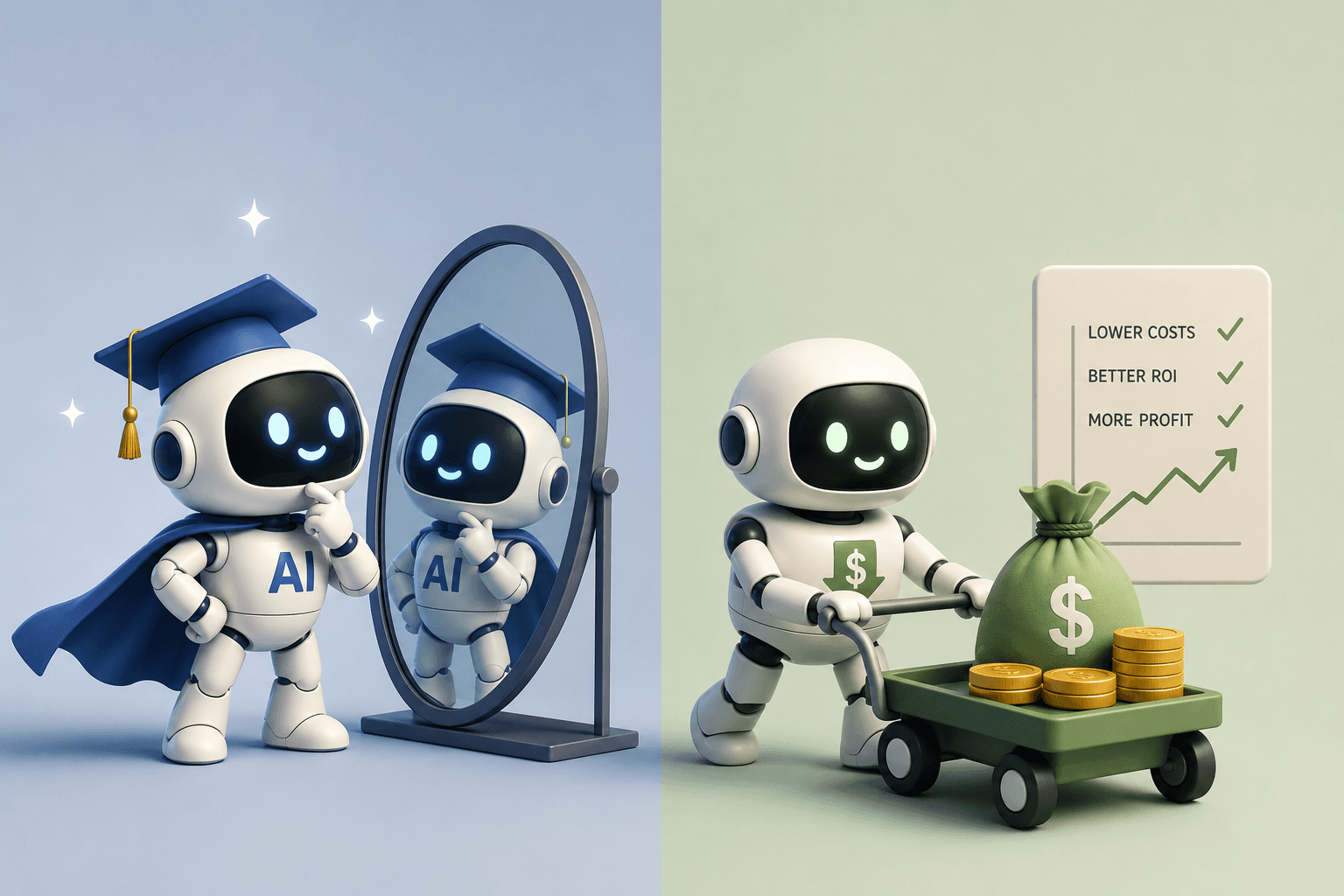
Somewhere in Dubai right now, a business is renewing a subscription to an AI tool nobody on the team actually opens anymore. And somewhere else, a business just quietly saved forty hours of manual work this month using a system so unglamorous it's never once come up in a client meeting.
That's the gap this article is about. Not "is AI worth it" that question's basically settled. The real question is: which AI is worth it? Because "smart-looking" and "money-saving" get treated as the same thing constantly, and they're often not even close. This distinction sits at the heart of how businesses should actually evaluate AI solutions Dubai vendors are increasingly offering across every industry.
If you're a UAE business owner or decision maker weighing where to put your next AI budget, this distinction is probably the single most useful filter you can apply more useful than any feature comparison, any vendor pitch, any "top AI tools" listicle. Let's break down how to actually tell the two apart.
Two Different Products, One Confusing Label
"AI" has become a single word covering wildly different things. A chatbot that writes engaging marketing copy is AI. A system that automatically catches a pricing error before it costs you money is also AI. Both get marketed under the same umbrella term, priced in similar ranges, and pitched with similarly confident language but they solve fundamentally different problems.
The first category is built to demonstrate capability. It's designed to be shown off in a demo, a sales deck, a "look what AI can do now" LinkedIn post. It's often genuinely impressive as a piece of technology.
The second category is built to solve a specific operational problem, quietly, repeatedly, in the background. It rarely makes for a good demo because its value is in consistency and invisibility, not spectacle.
Here's the trap: businesses evaluating AI investments often use the same instinct for both "does this seem impressive" when only one category actually rewards that instinct. Business AI solutions that genuinely move the needle financially need to be evaluated on a completely different axis: does this reliably reduce a cost we can name.
The "Would I Pay For This If It Looked Boring?" Test
Here's a simple gut check worth running on any AI pitch, tool, or project proposal: strip away the interface, the branding, the demo polish. If this exact functionality were delivered through the ugliest, plainest spreadsheet and email system imaginable, would you still pay for it?
If the honest answer is yes because it's genuinely saving hours, catching errors, or preventing losses you're looking at something with real financial substance behind the AI label. If the honest answer is "well, no, because half the appeal is how slick it looks," that's worth sitting with. You might be buying the packaging, not the function.
This test cuts through a huge amount of noise, because it separates the AI itself from the presentation layer wrapped around it. AI implementation decisions get much clearer once you're evaluating the underlying function rather than the polish.
What "Looks Smart" AI Tends to Get Right (and Wrong)
To be fair to this category it's not fake, and it's not worthless. Conversational AI, generative tools, and flashy dashboards genuinely have real applications: drafting content faster, exploring data visually, answering general questions quickly. There's real value there, particularly for creative, exploratory, or communication heavy work.
Where it goes wrong is when businesses expect that same category of tool to deliver hard operational savings it was never built for. A tool that's excellent at generating a first draft of an email is not the same as a tool that eliminates the need for someone to process invoices. Expecting the former to deliver the latter's kind of ROI is where budgets get mismatched to outcomes.
The mistake isn't using this kind of AI it's misclassifying what it's for, and then feeling burned when it doesn't show up as a line item saving.
What "Saves Money" AI Actually Requires
Money saving AI has a few consistent traits worth recognizing, regardless of the specific application.
It targets a task with a countable cost. Hours spent, errors made, revenue lost to a delay, opportunities missed due to slow response something you can put a number on before and after.
It runs continuously, not occasionally. A tool used once a week for inspiration isn't going to move a P&L the way a system running every transaction, every shift, every day will.
It requires little to no behavior change to keep using it. The best cost saving intelligent automation sits inside processes your team already follows it doesn't ask them to adopt a whole new habit or remember to log into a separate tool.
It has a clear owner tracking its impact. Somebody in the business is watching the metric it's supposed to move, and can tell you in a sentence whether it's working.
If a proposed AI investment can check these four boxes, it's very likely to land in the "saves money" category, regardless of how visually unremarkable it might be.
A Practical Way to Sort Your Own AI Wishlist
If your business has a running list of "things we should probably use AI for," here's a fast way to sort it.
Write down every AI idea on the table right now from the team's Slack suggestions to the vendor demos you've sat through. Next to each one, answer two questions honestly: what specific cost does this reduce, and how would we know if it worked?
Ideas that get a clear, specific answer to both go in your "saves money" bucket these are worth prioritizing for real investment. Ideas that only get a vague answer ("it'll help us look more innovative," "it'll make things smoother") go in your "looks smart" bucket not necessarily worthless, but they shouldn't be competing for the same budget or urgency as the first bucket.
This simple sort alone tends to reveal that most businesses have far more "looks smart" ideas floating around than "saves money" ones which is exactly why it's worth doing deliberately instead of just chasing whatever's most talked about.
Once sorted, resist the urge to fund every idea in the "saves money" bucket at once, too. Pick the one or two with the clearest, most confidently estimated savings, and prove those out first. A track record of two or three genuinely successful, measurable AI implementations does more to build internal trust in AI implementation as a strategy than five simultaneous half finished projects with unclear results.
Measuring It Properly: Before, During, and After
A lot of the confusion between these two categories comes down to weak measurement. Businesses often skip establishing a real baseline before implementation, then have nothing solid to compare against afterward which makes it easy for an unremarkable tool to coast on vague positive impressions rather than hard numbers.
Before implementation, get a specific number: hours currently spent, error rate, average response time, whatever the tool claims to improve. Write it down. This step alone filters out a surprising number of proposals, because it's often the first time anyone's actually quantified the current cost of a problem everyone's been complaining about informally for months.
During the rollout, track the same metric consistently, ideally weekly, rather than waiting for a big end of quarter review. Early tracking catches both pleasant surprises and quiet underperformance while there's still time to adjust course.
After a reasonable period usually one to three months depending on the process compare honestly against the baseline. If the number moved meaningfully, that's a decision intelligence win worth scaling further. If it didn't, that's useful information too, and worth acting on rather than quietly extending the subscription out of inertia.
This measurement discipline is really what separates businesses that consistently get value from AI from those that accumulate a growing pile of underused tools it's not about picking smarter tools upfront, it's about honestly tracking whether the ones you picked actually delivered.
Where the Real Money Tends to Hide
Across UAE businesses, the AI applications that consistently deliver measurable financial return tend to cluster around a few unglamorous categories.
Error prevention. Systems that catch pricing mistakes, duplicate payments, incorrect stock counts, or compliance gaps before they become costly this is one of the highest, most reliably measurable returns in AI, because the savings are simply the cost of the mistake avoided.
Time recovery on repetitive tasks. Workflow automation applied to data entry, report generation, or approval routing frees up paid hours that were previously spent on work a system can now handle a direct, easily calculated saving.
Faster response cycles. Whether it's customer inquiries, internal approvals, or supplier communications, AI automation for businesses that shortens the time between a request and a response often shows up in retention, conversion, or reduced penalty costs all measurable, even if less obviously "AI" than a chatbot.
Better forecasting. Machine learning applied to demand, staffing, or inventory prediction reduces the cost of both over and under preparing money saved on excess stock, or revenue saved from stockouts, both trackable against historical baselines.
None of these show up well in a five minute demo. All of them show up clearly on a quarterly financial review.
A Word on Vendor Incentives
It's worth acknowledging plainly: some vendors have every incentive to sell you the impressive version, because it's easier to close a sale on a wow factor demo than a careful ROI conversation. This isn't necessarily dishonesty it's just how sales works but it means the burden falls on you to ask the harder, less exciting questions before signing anything. A genuine AI development company UAE businesses can trust will be comfortable walking through the numbers, not just the demo.
A good AI consulting Dubai partner will actually welcome this scrutiny. If a vendor gets uncomfortable or vague the moment you ask "what specific cost does this reduce, and by how much," treat that discomfort as useful information. The vendors confident in their numbers tend to lead with them, not avoid them.
Building This Into How You Evaluate AI Going Forward
The businesses that consistently make good AI decisions aren't necessarily more technical than everyone else they've just built a habit of asking "so what does this actually save us" before getting excited about what a tool can do. That single habit, applied consistently across every AI pitch, project idea, and vendor conversation, does more to protect an AI budget than almost any technical evaluation criteria.
It also changes how you listen to internal suggestions. When someone on the team says "we should get AI for this," the useful follow up isn't "does that sound cool" it's "what's this costing us right now, and what would this realistically save." Teams that build this reflex tend to end up with AI portfolios that are smaller, less flashy, and considerably more profitable than teams chasing every impressive sounding tool that crosses their radar.
Applying This Across Different Parts of the Business
The looks smart versus saves money distinction plays out a little differently depending on which part of the business is asking for AI investment, and it's worth tailoring the questions accordingly.
In marketing and content, the temptation toward "looks smart" AI is strongest, because the output itself a generated image, a slick campaign concept, a polished piece of copy is inherently visual and easy to get excited about. The money saving question here is less about the output quality and more about time: how many hours of drafting, editing, or asset production does this genuinely remove from a person's week, measured honestly against the quality of what it produces.
In operations and finance, the risk runs the other way teams sometimes dismiss AI too quickly because it doesn't feel exciting, missing genuinely valuable business process automation opportunities simply because nobody's pitched them with any flair. This is where actively asking "what's eating our time here that a system could handle" tends to surface real opportunities that would otherwise go unnoticed.
In customer facing teams, the two categories often blur together most, because a customer support chatbot can simultaneously look impressive to leadership and genuinely reduce response times or it can look impressive while quietly frustrating customers who can't get a straight answer. This is a category worth testing carefully with real customer feedback, not just internal enthusiasm, before assuming the impressive demo translates to an actual improvement in service.
Recognizing which pattern your own department or business tends to fall into chasing polish, or under investing in the unglamorous is itself a useful piece of self awareness worth building into how your business approaches every future AI decision, not just the current one on the table.
The Bottom Line
AI that looks smart and AI that saves money aren't enemies plenty of tools genuinely do both. But treating them as interchangeable is how a lot of businesses end up with an AI budget full of subscriptions nobody quite remembers signing up for, alongside a handful of quiet, unglamorous systems doing the actual heavy lifting.
Before your next AI investment, run the boring test: strip away the polish, name the specific cost it reduces, and ask whether you'd still want it if it looked like a plain spreadsheet doing its job in the background. If the answer's yes, you've probably found the kind of enterprise AI solutions that actually pay for themselves. If the answer's no, that's fine too just know what you're buying, and budget for it accordingly.
Frequently Asked Questions:
1) What is the difference between AI that looks smart and AI that saves money?
AI that looks smart is built to impress in a demo or pitch, while AI that saves money is built to reduce a specific, measurable cost like hours spent, errors made, or revenue lost to delays. The first is judged on how capable it appears; the second is judged on whether a number actually moves.
2) How can a business tell if an AI tool is actually saving money or just looks impressive?
Check whether it targets a cost you can name, runs continuously rather than occasionally, requires little behavior change to keep using, and has a clear owner tracking its impact against a real baseline. If a tool checks those boxes, it's very likely delivering genuine financial value rather than just polish.
3) Why do some AI investments fail to deliver ROI even though the technology works well?
Most AI investments that fail to deliver ROI aren't technically broken they were never matched to a specific, measurable problem in the first place. A capable tool applied to a vague goal like "be more innovative" rarely shows up in the numbers, regardless of how well it performs technically.
4) What questions should I ask an AI vendor to know if their product actually saves money?
Ask for a specific metric they expect to move and by how much, what happens if the projected savings don't materialize, and whether you can speak to an existing client in a similar industry or size. Vendors confident in their numbers usually lead with them rather than deflecting toward broader talk about innovation.
5) Does an AI tool need to look impressive to be worth buying?
No. Some of the most financially valuable AI systems have plain, unremarkable interfaces their value comes from consistently reducing a specific cost in the background, not from how they present in a demo.
6) What is the biggest mistake businesses make when choosing AI tools?
The most common mistake is evaluating an AI tool on how capable or innovative it seems, instead of asking what specific, measurable cost it will reduce. That mismatch is why so many AI subscriptions end up unused within a few months.
7) How long does it take to know if an AI investment is actually paying off?
For a well scoped, specific use case, most businesses can tell within one to three months by comparing results against a baseline measured before implementation. Broader AI initiatives spanning multiple systems usually take longer to show a full financial picture.
8) Is generative AI the same as cost-saving AI automation?
Not necessarily. Generative AI tools are often built for content creation, drafting, and exploration, while cost saving automation is built to eliminate a specific repetitive task or catch a specific type of error the two can overlap, but they're evaluated on different criteria.
9) Why do AI subscriptions often go unused after the first few months?
AI tools tend to fall out of use when they require a separate habit or login that doesn't fit naturally into a team's existing workflow. Tools that save money reliably are usually the ones embedded directly into processes people already follow daily.