Automation Strategy
What UAE Companies Should Automate Before Investing Heavily in AI
4 min read · July 15, 2026
Many UAE companies are investing in AI before automating their core business processes. Discover which business operations should be automated first and how a strong automation strategy helps maximize AI investments.
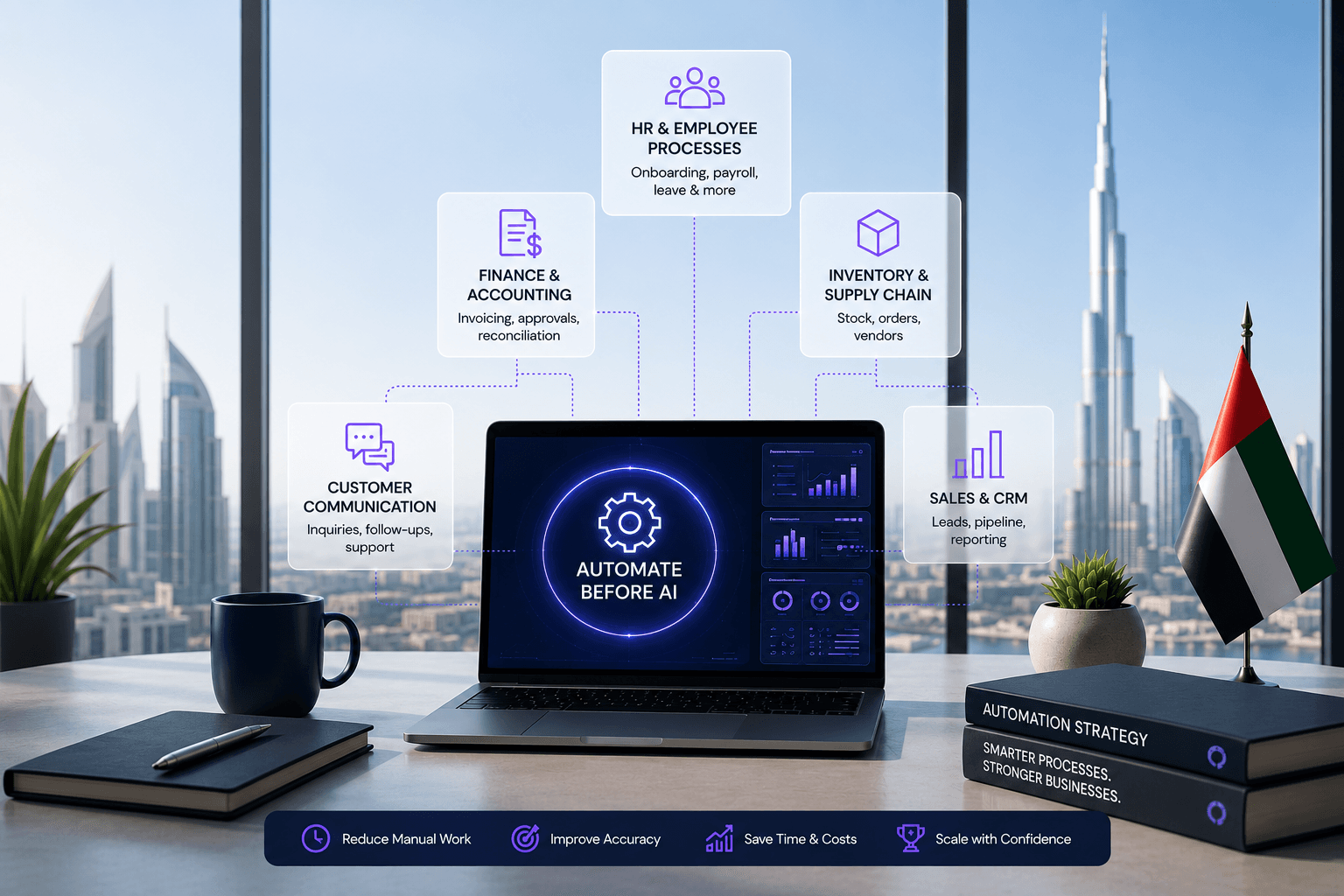
Before spending big on AI, fix your basics first — clean data, connected systems, and automated workflows. Without that foundation, even the smartest AI tools won't perform the way you expect.
A lot of UAE businesses are rushing to adopt AI, and for good reason. The market is evolving rapidly, and companies want to stay competitive. However, one of the biggest mistakes businesses make is investing in AI before automating their core operations.
AI delivers the best results when it's built on structured, connected, and reliable data. If your business still relies on spreadsheets, WhatsApp approvals, manual data entry, and disconnected software, AI won't have the quality information it needs to generate accurate insights.
At Oglas AI, we help UAE businesses build a strong digital foundation by streamlining operations, connecting business systems, and preparing organizations for successful AI adoption. The smartest AI investments begin with well-automated processes.
Here's what every UAE company should automate before investing heavily in AI.
1. Payroll and HR Processes
Payroll and HR are often the best places to begin automation. Manually calculating salaries, tracking attendance, managing leave requests, and processing employee records consume valuable time every month. These repetitive, rule-based tasks are ideal for automation.
Beyond saving time, automated payroll systems help businesses stay compliant with UAE labor regulations, including salary calculations, end-of-service benefits, and reporting requirements. Reducing manual errors also minimizes costly compliance risks.
2. Connect Data Across Departments
Before AI can generate meaningful insights, your business data needs to work together.
Many organizations store information separately across HR, finance, sales, operations, and customer service. When data lives in disconnected systems, generating reports becomes slow, inaccurate, and heavily dependent on manual work.
Connecting departments through centralized business systems allows information to flow automatically. This creates a reliable data foundation that AI can analyze effectively. Without clean and connected data, AI produces unreliable results.
3. Automate Repetitive Customer and Employee Queries
Every business receives the same questions repeatedly.
Customers ask about order status, invoices, or payment dates. Employees ask about leave balances, HR policies, or payroll schedules.
These high-volume, repetitive interactions can be automated using structured workflows, self-service portals, or chatbots. Automating these tasks improves response times while reducing the workload on support and HR teams.
More importantly, these automated interactions help build a structured knowledge base, making future AI assistants significantly more accurate and useful.
4. Streamline Document and Approval Workflows
Many companies still rely on email chains and manual approvals for contracts, invoices, purchase requests, onboarding documents, and internal approvals.
These manual workflows create unnecessary delays, increase the risk of errors, and make it difficult to track progress.
Automating document workflows routes requests to the right people automatically, sends reminders, tracks approval history, and maintains complete transparency without removing human decision-making.
For many businesses, this alone can save several working days every month.
5. Automate Reporting and Business Visibility
If preparing a management report requires collecting spreadsheets from multiple departments, your reporting process should be automated before investing in AI.
Real-time dashboards automatically gather data from different business systems, giving leadership immediate access to accurate business performance.
This is especially important because AI-powered analytics depend entirely on the quality of incoming data. Automated reporting ensures AI recommendations are based on current, reliable information rather than outdated or incomplete reports.
Why This Order Matters
AI is incredibly powerful—but it works as an enhancement layer, not a replacement for strong operational processes.
Businesses that first automate payroll, centralize data, streamline approvals, and improve reporting create an environment where AI can generate meaningful insights and measurable business value.
Companies that skip these foundational steps often end up with expensive AI tools that still require constant manual corrections, limiting their return on investment.
Strong automation creates the stable foundation that allows AI to deliver real business impact.
The Practical Starting Point
Digital transformation doesn't have to happen all at once.
Begin by identifying the process that creates the biggest operational bottleneck—whether it's payroll, approvals, reporting, or data management. Automate that area first, then gradually connect the rest of your business processes.
Once your operations are streamlined and your data is clean, connected, and reliable, AI becomes far more effective.
The smartest investment isn't adopting AI first—it's preparing your business so AI can truly deliver its full potential.